You have the product idea. Maybe it is a barrier-support moisturiser, a pigmentation serum, a body treatment or a new scalp-care product. Then comes the obvious question:
“How soon can we launch?”
The answer depends largely on the route you choose.
A white-label product can move significantly faster because the formulation has already been developed and tested. A completely custom product needs formulation, sampling, refinement, testing, packaging decisions and manufacturing before it is ready for market. It therefore becomes difficult to publish one fixed delivery timeline for every private-label project; the timeline depends on the complexity and requirements of the individual product.
The most useful way to understand skincare product development time is understanding where the time actually goes.
There Is No Single Skincare Development Timeline
One product may move smoothly from a clear brief into formulation and approval. Another may involve several prototypes, specialist actives, bespoke packaging, and multiple rounds of feedback.
Those cannot realistically have identical schedules.
The development route matters too. White label removes much of the formulation stage because the product foundation already exists. Custom development deliberately adds time because the objective is different: you are creating something tailored to the brand rather than selecting something already developed.
Stage 1: Turning the Idea Into a Proper Product Brief
A manufacturer needs to understand what type of product you want, who will use it, what problem or experience it is intended to address, how you want it to feel, your ingredient direction, packaging considerations, budget awareness and expected launch timing.
Emulcfy uses its product-realisation process to bring these questions into the formulation journey before development progresses.
This stage can move very quickly when the founder has clear answers. It can also become the first major source of delay when the concept is still changing.
That is not necessarily a problem. Discovering that the idea needs more thought before formulation is far better than discovering it after several prototypes have already been developed. Clarity at the start saves time later.
Stage 2: Formulation and the First Prototype
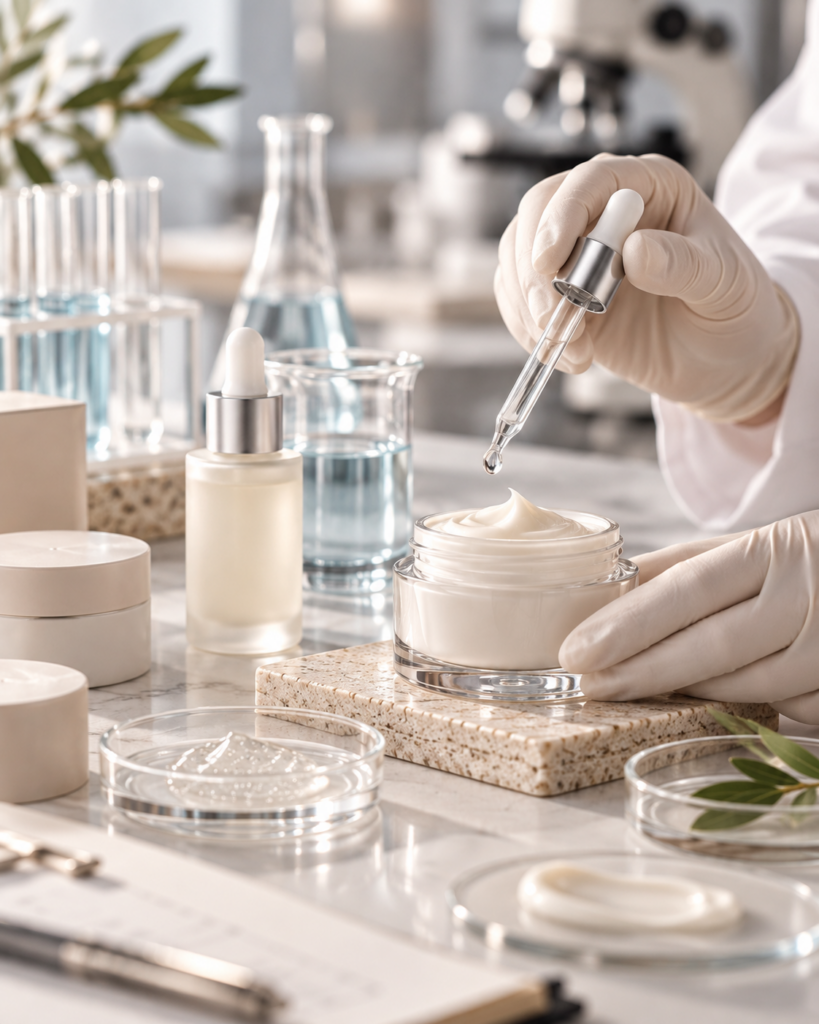
Once the brief is understood, the technical work begins. This is where an idea starts becoming a physical product.
The formulator needs to build a system in which ingredients work together, the intended texture can be achieved, the product remains appropriate for its intended use, and the formula can eventually move beyond a laboratory sample into manufacturing.
A prototype is then produced for assessment. This is an important moment because a written brief and a physical sample are very different things. For example:
“Lightweight” may mean something different to two people.
“Rich but non-greasy” sounds perfectly clear until you have two different creams in your hands.
The prototype gives the founder and formulator something real to respond to. Development therefore should not be judged purely on how quickly the first sample appears. While a fast prototype is very useful, the main goal should be to create a prototype that gives the right technical direction.
Stage 3: Sample Review and the Feedback Loop
Once a sample is produced, the brand needs to evaluate it thoughtfully.
- Does the texture match the intended positioning?
- Does it spread properly?
- Does the fragrance feel appropriate?
This is where projects often either accelerate or stall. Focused feedback such as:
“We like the absorption and fragrance, but want slightly less viscosity.”
is actionable. Feedback like:
“It isn’t quite right. Can you make it more premium?”
requires much more interpretation. At Emulcfy, the private-label process includes a feedback loop in which samples and test results are reviewed, and adjustments can be made before final confirmation. The real secret to success lies in how well founders and manufacturers work together to realise the product’s vision.
Stage 4: Testing the Product Before You Depend on It
Commercial products need to behave acceptably over time. Stability studies assess whether a cosmetic product maintains the required physical, chemical, microbiological, functional, and sensory characteristics under relevant storage and use conditions.
International guidance also recognises that no universal test protocol fits every cosmetic product; therefore, testing needs to reflect the specific formulation and its expected conditions.
At Emulcfy, compatibility and stability testing are conducted as part of its development capabilities. Testing is not an administrative delay between formulation and selling; it is part of finding out whether the product you developed is actually suitable for the job you expect it to do.
Stage 5: Packaging Needs Its Own Timeline
While formulation receives most of the attention, packaging can quietly determine whether a launch happens on time. A brand may need bottles, jars, pumps, lids, cartons, labels, decoration or specialised dispensing systems.
Some components may be readily available. Others may have supplier lead times, minimum order quantities or international sourcing requirements.
And packaging is not independent of formulation. The product needs to dispense properly; materials need to suit the formulation, and the pack needs to withstand normal storage and handling. The final result needs to work practically and look good.
Packaging conversations should happen early enough to run alongside development wherever possible. Waiting until formulation is completely finished before thinking about packaging can turn two parallel workstreams into two consecutive ones, and that costs time.
Stage 6: Finalising Labels, Claims and Product Information
Packaging artwork can feel like a marketing task. It is also a technical task.
Ingredient information needs to be correct. Product claims need to be considered. Directions and warnings may need attention depending on the product. The product name and marketing language should not promise something the formulation cannot support.
The South African Cosmetic, Toiletry & Fragrance Association provides industry guidance on ingredients, product claims, packaging, and labelling, while the country’s draft regulations relating to cosmetic labelling, advertising, and composition remain under regulatory review.
This is another reason not to leave artwork to the final few days before production. Beautiful packaging with incorrect information is not finished packaging.
Stage 7: From Laboratory Formula to Manufacturing
Approving a laboratory sample does not mean somebody simply makes a much bigger bucket of the same thing.
Commercial manufacturing introduces scale. Equipment is different. Batch quantities are different. Mixing conditions need to be controlled. Raw materials need to be prepared.
This is the point at which a product concept becomes a repeatable commercial product.
At Emulcfy, our current private-label workflow brings formulation, manufacturing, filling and packaging into the same overall development process rather than treating them as unrelated services.
Stage 8: Filling, Labelling and Final Sign-Off
Once the bulk product is ready, it still needs to become something a customer can actually buy. That means filling into the selected packaging, applying the required labels or decoration, completing production checks and preparing the finished product for delivery.
It sounds easy because the formulation work is already done. But even here, coordination matters.
- Packaging must be available.
- Labels must be correct.
- Quantities need to align.
- Production slots have to be planned.
The finished product then needs final approval before it enters the market.
What Usually Delays a Skincare Launch?
Technical complexity certainly affects timelines, but some of the biggest delays come from decisions.
- A vague brief slows formulation because the target keeps moving.
- Slow sample feedback leaves the project waiting between development rounds.
- Changing ingredients halfway through development may trigger additional reformulation or testing.
Launching too many products simultaneously increases the number of decisions, samples, components and approvals that must happen at once.
The common thread in all of this is not simply that “skincare takes time”; it is that every unresolved decision creates another dependency later in the process.
How Can You Develop a Skincare Product Faster Without Cutting Corners?
The biggest opportunity is not to rush the laboratory. It is to reduce unnecessary uncertainty. If speed is the most important business requirement, consider whether white label can achieve the commercial objective without a full custom formulation process. At Emulcfy, our white-label route begins with already developed and tested formulations, then moves into MOQ selection, branding, and order completion.
If custom formulation is necessary, arrive with a strong brief.
- Know who you are creating the product for.
- Decide which characteristics are non-negotiable.
- Give clear feedback on samples.
- Avoid adding ingredients simply because they are trending after development has already begun.
Consider whether your first launch genuinely needs six products, or whether one excellent hero product would let you move with greater focus. Speed in product development usually comes from good decisions made at the right time.
White Label or Custom: Which Route Is Faster?
White label is usually the faster route because the formulation stage is largely complete before your brand enters the process.
Custom formulation takes longer because the product needs to be designed, refined and validated for your specifications.
That does not make custom formulation inefficient. It means you are buying something different. White label offers speed and simplicity, while custom development gives you greater control and differentiation.
So, How Long Does It Take to Develop a Skincare Product?
If you use a pre-developed white-label formulation, your route to market can be much shorter because much of the product-development work has already happened.
If you are developing a custom formulation, plan for a journey rather than a single production date.
Your timeline may need to account for briefing, formulation, prototypes, feedback, testing, packaging, artwork, sourcing, manufacturing, filling, labelling and final approval.
That is a more useful way to plan. Start with your intended launch date, then work backwards through the decisions and technical steps required to make that date realistic.
Frequently Asked Questions
How long does private-label skincare take to develop?
There is no single timeline for every private-label product. Complexity, formulation work, feedback rounds, testing, ingredient availability, packaging and specialist testing requirements can all influence the schedule.
Is white label faster than custom skincare formulation?
Yes, generally. White-label formulations are already developed and tested, removing much of the R&D required for a custom formulation.
Can you skip stability testing to launch faster?
Testing should be based on the product’s needs rather than the desired launch date. Stability assessment shows how the formulation behaves over time and under relevant conditions, so removing necessary testing to accelerate launch introduces avoidable risk.
What is the biggest cause of avoidable product-development delays?
Unclear or changing decisions are major contributors. A strong brief, focused feedback, early packaging planning and clear approval responsibilities can reduce unnecessary back-and-forth.
Should I choose my packaging before contacting a manufacturer?
You do not need every packaging specification finalised, but having a direction helps. Consider packaging early because the formula, dispensing system, compatibility, cost, and product experience need to work together.
When should I contact a skincare manufacturer if I have a target launch date?
As early as possible. A manufacturer can help determine whether your timeline is realistic and whether white-label, private-label, or custom development is the best route.
Have a Launch Date in Mind?
Talk to Emulcfy about your product idea, desired launch timing, expected volumes and development route so the project can begin with a realistic path from brief to finished product.